

Miraculous Medal Symbols Explained: A Complete Guide
Table of Contents
What the Miraculous Medal Symbols Represent
History of the Miraculous Medal
Miraculous Medal Symbols on the Front
The Letter M and Cross
The Two Hearts
Mary Standing on the Serpent
Miraculous Medal Symbols on the Back
The Cross and Intertwined Hearts
The Twelve Stars
The Rays of Light
The Medal's Inscriptions and Their Meaning
How to Use the Miraculous Medal Prayer
Catholic Teaching vs. Popular Interpretation
Wearing and Blessing Your Miraculous Medal
Frequently Asked Questions
Last Updated: October 21, 2026
What the Miraculous Medal Symbols Represent
The Miraculous Medal symbols carry profound spiritual meaning rooted in Catholic devotion to Mary and Christ's redemptive work.
At Miraculous Medals, we offer a curated selection of religious medals, including Miraculous and Benedictine designs, serving the Catholic community as a symbol of Mary's protection. This medal becomes a daily reminder of Mary's intercession and Jesus's salvation.
The front emphasises Mary as the Immaculate Conception; the reverse focuses on Christ's Passion and redemption. Together they present a complete theological message: Mary leads us to Jesus, and Jesus offers salvation through His sacrifice.
History of the Miraculous Medal
The Miraculous Medal originated from apparitions in Paris during 1830.
Catherine's testimony describes Mary appearing in brilliant light, wearing rings that cast rays of grace downward, and showing her the design that would become the medal in such detail she could describe it to her spiritual director.
Church authorities examined Catherine's claims, verified her character, and authorised the medal's production and distribution, recognising Marian devotion as a legitimate spiritual practice. This ecclesiastical approval distinguishes the Miraculous Medal from unvetted religious items.
Miraculous Medal Symbols on the Front
The front presents Mary standing upon a serpent, with the letter M and cross above her, emphasising her role in salvation history and her triumph over evil.

The Letter M and Cross
The letter M crowned by a cross represents Mary's connection to Christ's redemptive mission. The M stands for Mary, Mother of God, whilst the cross above it symbolises Jesus Christ and His Passion, conveying that Mary is inseparable from Christ and her role as mother of the Saviour is central to salvation.
The cross recalls Christ's crucifixion, the moment Jesus accomplished humanity's redemption. It declares that Mary points us toward Christ, whose sacrifice is the source of all grace. Its position above the M also suggests Christ's authority and divinity reign above all creation, including Mary, a distinction that prevents Mary-worship whilst honouring her unique role.
The Two Hearts
Directly beneath the M are two intertwined hearts. The left represents the Sacred Heart of Jesus, pierced by a lance and often crowned with thorns; the right represents the Immaculate Heart of Mary, pierced by a sword, referencing Luke's Gospel prophecy that "a sword will pierce your own soul too."
These hearts symbolise the profound love of Christ and Mary for humanity: Jesus's Sacred Heart radiates divine love and mercy, whilst Mary's Immaculate Heart reflects her perfect love and maternal compassion. Both are pierced, speaking to suffering endured for our sake, Christ's physical on the cross and Mary's spiritual as she witnessed her son's Passion.
Mary Standing on the Serpent
Mary standing firmly upon a serpent represents her triumph over evil and sin. The serpent symbolises Satan, the deceiver who led humanity into sin in the Garden of Eden. Mary's dominance over it declares that through her Immaculate Conception, her freedom from original sin, she stands victorious against evil.
This connects to the Genesis prophecy that God would place enmity between the serpent and the woman, and that her offspring would crush the serpent's head.
Miraculous Medal Symbols on the Back
The reverse side shifts focus to Christ's redemptive work and the Church's sacramental life, emphasising the cross, the hearts, and symbols of grace flowing to the world.
The Cross and Intertwined Hearts
The back features a large cross above two intertwined hearts, the same Sacred Heart of Jesus and Immaculate Heart of Mary seen on the front but arranged differently. Here the cross dominates, emphasising that Christ's redemption is the source from which all grace flows through Mary's intercession.
The cross represents Christ's Passion and resurrection, the central mystery of Christian faith, a symbol not merely of suffering but of triumph, for through His death and resurrection Christ conquered sin and death. The hearts beneath show that this redemptive work flows from Christ's love and is made accessible through Mary's maternal intercession.
The Twelve Stars
Surrounding the reverse side are twelve stars in a circle, representing the twelve tribes of Israel and the twelve apostles, symbolising the fullness of God's people, both the Old Testament faithful and the New Testament Church. They also reference the Book of Revelation's vision of a woman crowned with twelve stars, which Catholic tradition identifies as Mary.
The stars emphasise Mary's role as queen of heaven and mother of the Church, suggesting her intercession extends to all God's people across all times. They remind you that you're part of a vast communion of saints and faithful stretching back through centuries, united in devotion to Mary and Christ.
The Rays of Light
Emanating from the hearts on the reverse side are rays of light, often streaming downward. These represent the graces that flow from Christ's redemptive work and Mary's intercession to those who seek them, purposeful and directed, flowing from heaven to earth.
These rays connect to Saint Catherine's vision, in which she saw Mary wearing rings that cast rays of grace. They symbolise that wearing or carrying the medal isn't passive but a means of receiving actual spiritual grace, a channel through which you consciously open yourself to God's mercy, protection, and strength. Grace is active, generous, and available to those who ask.
The Medal's Inscriptions and Their Meaning
The Miraculous Medal bears inscriptions on both sides that complement the visual symbols and deepen your appreciation of its spiritual purpose.
The front typically bears the inscription "O Mary, conceived without sin, pray for us who have recourse to thee." This acknowledges Mary's Immaculate Conception, her unique freedom from original sin, and asks for her intercession, placing yourself explicitly under her maternal care.
The inscriptions transform the medal from a symbol into a prayer object. Reciting these words is an active spiritual practice, not merely wearing a decorative item, anchoring the symbols in explicit theological meaning and guiding your intention during moments of doubt, fear, or need.
How to Use the Miraculous Medal Prayer
Using the Miraculous Medal prayer deepens your devotion and opens you to the graces it represents.
You can pray it once as a quick petition or repeat it as a meditation.
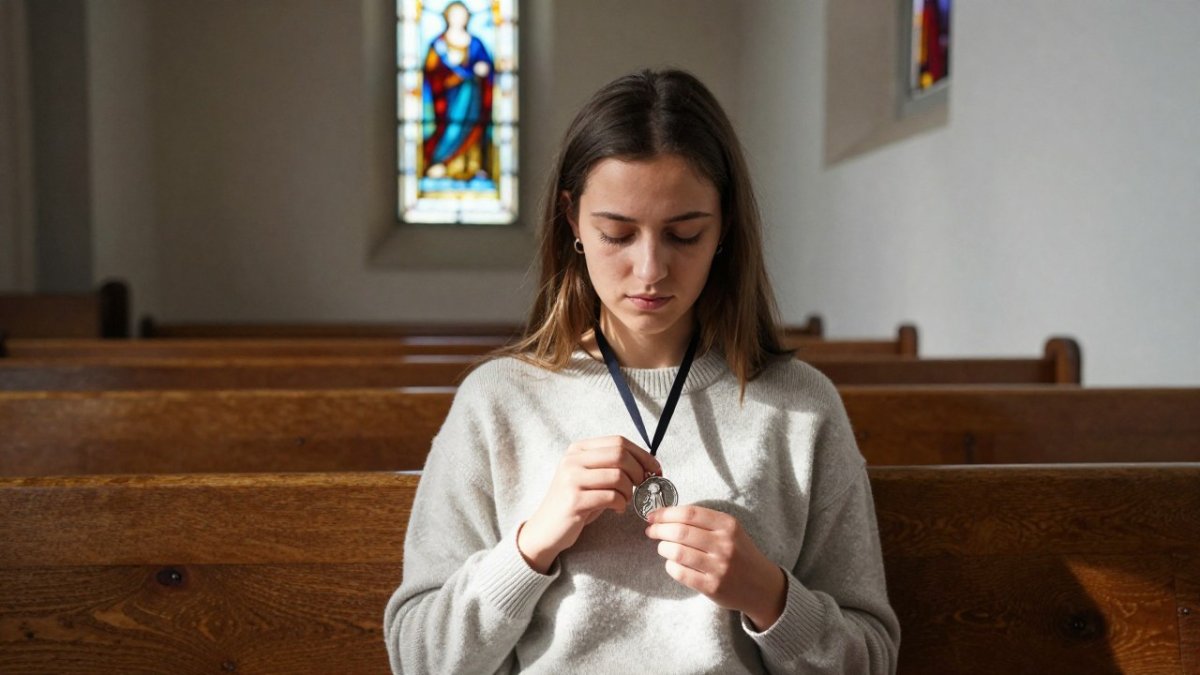
Another approach is wearing the medal visibly and pausing for a brief prayer whenever you notice it, turning it into a spiritual anchor throughout your day.
The medal's power comes not from magic but from your faith and intention. As a sacramental pointing toward spiritual reality, it works most effectively with genuine prayer and trust in God's mercy.
Catholic Teaching vs. Popular Interpretation
Catholic teaching distinguishes between legitimate Marian devotion and practices that cross into superstition or idolatry. Understanding this protects your faith and ensures your use of the medal aligns with Church doctrine.
The Church teaches that Mary, whilst honoured and venerated, is not divine and cannot grant grace directly. She's the Mother of God, but remains a creature dependent on God like all of us. Wearing the medal doesn't create magical protection independent of God's will; it's a means of asking Mary to pray for you, as you might ask any holy friend to intercede on your behalf.
A common popular interpretation treats the medal as a talisman that automatically prevents harm.
Some Catholics mistakenly believe the medal functions like a sacrament, automatically conveying grace through its physical presence. The Church clarifies that sacraments, baptism, confirmation, Eucharist, and others, are the primary means of receiving grace.
The Church also cautions against superstitions like believing the medal must never be removed, that it will fall off if you're in mortal sin, or that it guarantees answered prayers.
Wearing and Blessing Your Miraculous Medal
Wearing the Miraculous Medal is a personal devotional choice. Many Catholics wear it on a chain, visible or hidden, whilst others carry it in a pocket or bag.
Before wearing the medal, it's customary to have it blessed by a priest, setting it apart for sacred use and invoking God's grace upon it.
The medal works best with active faith. Worn passively, without prayer or intention, it reduces to jewellery.
At Miraculous Medals, we understand that finding the right medal and having it available when you need it matters.
The Miraculous Medal invites you into a centuries-old tradition of Marian devotion and trust in Christ's redemption.
Frequently Asked Questions
What do the symbols on the Miraculous Medal mean?
The Miraculous Medal symbols represent Christ's redemption and Mary's protection. The front features the letter M with a cross, symbolising Mary and Christ's Passion. The two hearts below represent the Sacred Heart of Jesus (crowned with thorns) and the Immaculate Heart of Mary (pierced by a sword). The back shows a cross above the intertwined hearts, with an M beneath and a serpent underfoot, all signifying victory over sin and salvation through Mary's intercession.
What does the M on the Miraculous Medal stand for?
The M represents Mary, the Mother of God and the Immaculate Conception. In Catholic teaching, Mary is the channel through which God's graces flow to humanity. The M is positioned above a cross, showing that Mary's role is inseparable from Christ's redemptive work. This placement emphasises that devotion to Mary always leads to Christ, the source of all salvation and grace.
What is the history of the Miraculous Medal?
The Miraculous Medal originated from apparitions of the Blessed Virgin Mary to Saint Catherine Labouré, a French nun, in 1830. During these visions, Mary revealed the medal's design and instructed that it be struck and distributed widely. Mary promised that those who wear the medal with faith and devotion would receive graces and protection. The medal became known as 'miraculous' because of the spiritual and physical healings reported by the faithful who wore it with trust in God's mercy and Mary's intercession.
How do I use the Miraculous Medal prayer?
The traditional Miraculous Medal prayer is: 'O Mary, conceived without sin, pray for us who have recourse to thee.' Pray this while wearing or holding the medal, especially during times of spiritual struggle, uncertainty, or need. Many Catholics recite it daily as part of their devotion to Mary. The prayer affirms belief in Mary's Immaculate Conception and asks for her maternal intercession with God. Wearing the medal while praying strengthens the spiritual connection and deepens your trust in Mary's protection.
What do the two hearts on the Miraculous Medal represent?
The two hearts symbolise the Sacred Heart of Jesus and the Immaculate Heart of Mary. The Sacred Heart, crowned with thorns, represents Christ's love, suffering, and redemption of humanity through His Passion. The Immaculate Heart, pierced by a sword, represents Mary's sorrowful compassion and her role as intercessor. Together, they show that Christ's redemptive love and Mary's maternal care work in union for the salvation of souls. This imagery emphasises the inseparable connection between Christ and His Mother in God's plan.
Why is Mary standing on a serpent on the Miraculous Medal?
Mary standing on the serpent symbolises her victory over sin and evil. In Catholic theology, the serpent represents Satan and sin, which entered the world through the fall of Adam and Eve. Mary, as the Immaculate Conception, was preserved free from sin and remains untouched by evil. Her position above the serpent shows that through God's grace, Mary triumphs over Satan and all spiritual darkness. This image reassures the faithful that devotion to Mary offers protection and victory over temptation and spiritual harm.
What do the twelve stars on the Miraculous Medal represent?
The twelve stars surrounding Mary on the back of the medal represent the Woman described in the Book of Revelation, chapter 12, who is clothed with the sun and has twelve stars on her head. Catholic tradition identifies this Woman as Mary, the Mother of Jesus. The stars symbolise Mary's queenship in heaven and her role as the Queen of Heaven. They also represent the twelve tribes of Israel and the twelve apostles, connecting Mary to God's covenant people and the foundation of the Church, emphasising her central place in salvation history.
What is written around the Miraculous Medal?
The front of the medal bears the inscription 'O Mary, conceived without sin, pray for us who have recourse to thee.' This phrase affirms Mary's Immaculate Conception and invites the faithful to seek her intercession. The back features the letter M with a cross above it, and below are the initials 'M' and a cross, along with the serpent beneath Mary's feet. Some versions include the year 1830, marking the apparitions to Saint Catherine Labouré. These inscriptions and symbols together communicate the medal's spiritual purpose: to invoke Mary's protection and grace through prayer and faith.
Shop Miraculous Medals

Comments