

5 Ways a Medal Can Support Your Anxiety, and Its Limits
Last Updated: November 10, 2026
Quick Summary
Wearing medals anxiety support can offer real spiritual comfort, since a medal gives your hands something to hold and your mind a familiar point to return to. It does not change the brain chemistry behind anxiety, so it cannot replace professional care, prescribed treatment or support from people around you.
Spiritual comfort from a medal is separate from clinical treatment, and should not replace it.
There is little research directly testing religious medals as an anxiety treatment.
A medal can serve as a grounding anchor: hold it, notice its weight and edges, and breathe slowly.
Brief, frequent grounding moments work better than one long attempt, so keep the routine short.
Seek a GP or psychologist if anxiety affects sleep, work, relationships or daily life.
Want a medal for daily strength?
Miraculous Medals offers Miraculous and Benedictine designs, with a black cord included.
Table of Contents
Wearing a religious medal can offer real comfort to someone living with anxiety, but it is not a treatment for it. At Miraculous Medals, we hear from faithful Catholics who carry a medal on a cord through hard days and find that the small, steady weight of it becomes a reminder of Mary's protection. That comfort is genuine. The medal cannot replace professional care, prescribed treatment, or the support of people around you.
Anxiety is a recognised condition, and a medal does not change the brain chemistry behind it. What a medal can do is give your hands something to hold and your mind a familiar point to return to.
Keep the two ideas separate in your mind. Spiritual comfort is one thing. Clinical treatment is another. Wearing a medal as spiritual comfort belongs to the first.
What the Evidence Says About Medals and Anxiety
There is little research that directly tests religious medals as an anxiety treatment, so claims about their effect should be treated cautiously.
A useful way to think about it is to separate three things a medal might do:
Symbolic meaning. The medal stands for a devotion, a person or a promise. For a practising Catholic, that meaning can settle the mind because it frames the moment as one of trust rather than threat.
Ritual structure. Repeating a short prayer or a fixed sequence gives the mind a familiar routine.
Tactile grounding. The weight, edges and raised detail give your hands a physical point of focus.
None of these is a clinical intervention. A medal does not change brain chemistry, does not treat an anxiety disorder and does not replace therapy or prescribed medication. It can be included in a personal routine alongside professional care.
Be sceptical of promises. Claims that a particular medal will cure anxiety, remove the need for treatment or produce guaranteed relief are not supported by evidence. A balanced position is that a medal may offer personal, symbolic comfort for some people.
Watch out: if you find yourself avoiding treatment, delaying a GP visit or spending money you cannot spare on medals in the hope of a cure, that is a sign to step back and speak to a health professional.
How to Choose Durable Catholic Medals for Daily Wear
If you plan to wear a medal every day, durability matters. A medal that tarnishes, flakes or breaks will not give you much comfort.
Look for these points when you choose:
Material quality: Solid, well-finished metal holds up better than thin plating.
Clear detail: Crisp engraving or relief stays readable over time.
A sturdy cord: A strong black cord is easier to wear every day than a fragile chain.
Size and weight: Choose a medal you can comfortably wear without it catching on clothing.
Our medals are provided in quality condition, and we include a black cord so you can wear yours straight away. You can also read related guidance on wearing Catholic medals for daily strength.
The St. Dymphna Medal Meaning and Its Place in Anxiety Devotion
St. Dymphna is widely invoked by Catholics who live with anxiety, depression and emotional suffering. Many people wear a medal of St. Dymphna as a devotional reminder of her intercession.
Understanding the meaning of the medal can deepen that devotion. You can learn more about the symbols and prayers on the Benedictine medal. The image and inscription serve as a focus for prayer, not a guarantee of relief. Approach it as you would any sacramental: as a support for faith, offered alongside honest care for your mental health.
Step-by-Step: Using a Medal as a Grounding Object
Grounding means bringing your attention back to the present when anxiety pulls it into the future or the past. A medal can serve as a simple anchor because it is small, familiar and always with you. The aim is not to suppress anxiety but to give your attention somewhere steady to rest.

Pause and settle. Sit or stand somewhere you will not be interrupted for a few minutes. Let your shoulders drop.
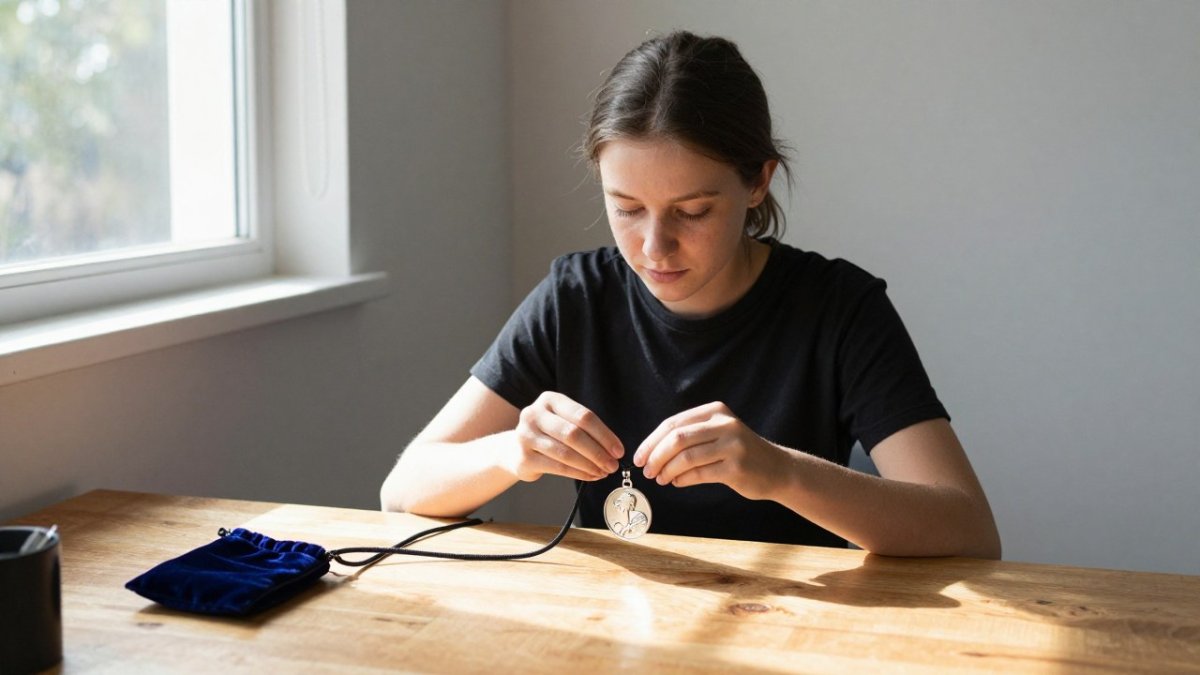
Take the medal in your hand. Hold it in your palm or between thumb and forefinger. If it is on a cord, hold the medal itself rather than pulling on the cord.
Notice the physical detail. Feel the weight, the temperature, the edges and the raised image. Describe it silently if that helps: smooth, cool, raised, round.
Breathe out slowly. A longer exhale than inhale is a common way to settle the body. Try breathing in for a count of four and out for a count of six, without forcing it.
Add a short prayer or phrase. Use a familiar prayer or a single word you can return to. The repetition is the point, not the length.
Return to what you were doing. When you notice anxiety rising again, repeat the steps. Brief and frequent is usually more useful than one long attempt.
Setting Up a Daily Practice
Choose one small, reliable moment each day, after waking, before bed, or during a commute, to hold the medal and pause for a minute or two. A regular habit is easier to return to on hard days than an occasional attempt. Keep the routine short enough that you will actually do it.
Adapting It to Your Situation
Some people prefer to keep the medal in a pocket rather than around the neck, especially at work or during sport. Others use it only during prayer. There is no single correct method; the useful version is the one you can repeat without strain. Whether you carry the medal, wear it, or turn to another quiet ritual, Divine Light Codes can sit alongside these practices as a reminder to pause and notice what helps you feel grounded.
Practical Safety Notes
Never use a medal as a substitute for medication, therapy or other care you have been prescribed. Do not keep a cord around your neck if it feels tight, and remove it during sleep or rough activity if it causes discomfort. If you have sensitive skin, watch for irritation from metal or cord and switch to a pocket or pouch if needed.
Watch out: a grounding object can become a compulsion if you feel unable to cope without repeatedly checking or touching it. If the routine starts to increase your anxiety rather than ease it, stop and discuss it with your GP or psychologist.
When a Medal Is Not Helping
Symbolic objects help some people and not others. If a medal reminds you of loss, feels uncomfortable or simply does nothing for you, that is not a failure. Other grounding methods, slow breathing, a short walk, cold water on the wrists, or naming things you can see and hear, work for many people. The medal is one option among several, not a test of faith.
The steps below show how a medal can serve as a simple grounding anchor, and how often to use it.
Step | What to do | Time or frequency |
Pause and settle | Sit or stand where you won't be interrupted | A few minutes |
Take the medal in hand | Hold the medal itself, not the cord | Each session |
Notice physical detail | Feel weight, temperature, edges and raised image | Each session |
Breathe out slowly | Breathe in for four, out for six, without forcing | Each session |
Add a short prayer | Use a familiar prayer or a single word | Each session |
Return to activity | Repeat the steps when anxiety rises again | Brief and frequent |
Maintaining Religious Medals So They Last
Regular care keeps a medal looking and feeling its best. If a medal does break, see what to do with a broken religious medal.
Wipe it gently with a soft, dry cloth after wearing.
Keep it away from perfume, lotion and swimming pools.
Check the cord for fraying and replace it when it wears thin.
Store it in a small pouch so it does not scratch against other items.
When to Seek Professional Mental Health Support
A medal can be a comfort, but persistent or worsening anxiety needs proper support. Speak to your GP, a psychologist, or a mental health professional if anxiety affects your sleep, work, relationships or daily life.
If you ever feel unsafe or are thinking about harming yourself, contact emergency services or a crisis line straight away. In Australia, Lifeline (13 11 14) is available 24 hours a day (Lifeline crisis support).
Choosing Your Medal and Ordering from Miraculous Medals
Choosing a medal is a personal decision. Think about the devotion behind it, the feel of the medal in your hand, and how you plan to wear it each day.
Our range includes Miraculous and Benedictine designs, and we aim for same-day dispatch on all orders within Australia. Pricing depends on the design and quantity, so please visit our website for current prices.
Find the medal that speaks to you and wear it with faith and care. Shop Miraculous Medals today.
Frequently Asked Questions
Can wearing a religious medal provide comfort during anxious moments?
A religious medal can offer comfort in the way many personal objects do. Some people find that holding it or noticing its weight can bring their attention to prayer. This is a personal sense of reassurance, not a treatment. Research directly testing whether medals reduce clinical anxiety is limited, so the benefit is best understood as personal and devotional. If anxious feelings are intense, persistent or affecting daily life, a GP or mental health professional can offer evidence-based options alongside any spiritual practice you find helpful.
What is the significance of the St. Dymphna medal for anxiety?
St. Dymphna is traditionally invoked by Catholics as a patron of those suffering from anxiety, emotional distress and mental illness. Many faithful wear or carry a St. Dymphna medal as a reminder to pray for her intercession during difficult times. Its meaning is devotional: it expresses trust in God and asks for her prayers. It does not replace medical care, and people who find it meaningful often combine it with prayer, sacraments and professional support where needed.
How do I choose a durable medal for daily wear?
Look for medals made from materials that resist tarnishing, and check that the edges and bail are smooth and firmly attached. Consider a sturdy cord or chain that can be replaced easily. Medals intended for daily wear should be sized so they sit comfortably without catching on clothing. Miraculous Medals offers medals with an optional black cord for immediate wear. Pricing depends on the design, quantity and delivery, so please check the Miraculous Medals website for current prices.
Comments