

What Should You Do With a Broken Religious Medal?
Last Updated: November 4, 2026
Quick Summary
A broken religious medal that was blessed is a sacramental, so retire it with care rather than throwing it in the bin. Bury it in a quiet place, give it to your parish, or repair it if only the cord, chain, or jump ring failed.
Check whether the medal was blessed before deciding how to handle it.
Dig a shallow hole around 15 to 20 centimetres for burial.
Remove cords and chains before burying a medal.
Do not burn a metal medal; bury it, give it to your parish, or keep it.
Keeping a damaged medal is allowed, since the blessing does not vanish.
Table of Contents
Start With the Medal Itself: Is It Blessed?
Before you decide anything, ask one question: has this medal been blessed? A broken religious medal that was blessed is a sacramental, not just jewellery. That changes how you should treat it.
A sacramental is a sacred sign that the Church uses to prepare people to receive grace (Article 1 Sacramentals). Medals, rosaries, and holy water all fall into this group. A blessing sets an item apart for devotion. Once blessed, it should be handled with care, even after it breaks.
So check first. Was it blessed at a parish, by a priest, or during a commissioning? If you are unsure, when should a medal be blessed explains what a blessing means and how Catholics treat blessed objects.
Blessed and broken: treat it as a sacramental
Never blessed: it is a devotional item you can retire simply
Unsure: ask your parish priest for guidance
How to Dispose of a Blessed Medal Respectfully
Respectful disposal of a blessed medal means retiring it with care, not throwing it in the bin. The Church asks that sacramentals be treated with reverence once they can no longer be used.
Practically, that gives you a few options:
Set it aside until you decide, if you are unsure
Bury it in a quiet place
Burn it and return the ashes to the ground
Give it to your parish, which may know how to handle it
A common mistake is rushing. There is no deadline here. Take the time to choose an option that fits the medal's meaning to you.
If the medal is damaged but still whole, repair may come before disposal. We cover that next.
Repairing a Broken Religious Medal Before You Let It Go
Many broken medals can be repaired rather than retired. A snapped jump ring, a frayed cord, or a worn chain are fixable. The medal itself is often fine.
Diocese of Lafayette-in-Indiana
Start by looking at what actually broke:
Cord or chain snapped? Replace it. A new cord is simple to fit.
Jump ring bent or open? A jeweller can close or replace it.
Clasp failed? Swap the chain.
Medal cracked or bent? This is harder to fix and may not be worth it.
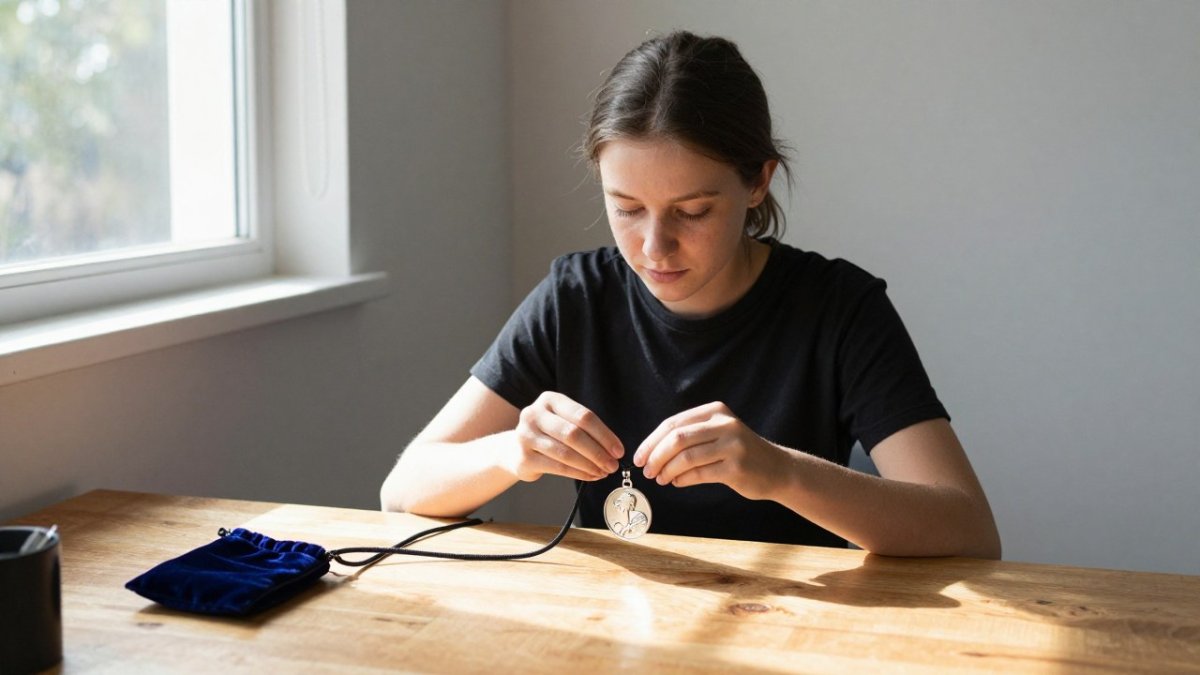
If the cord is the problem, how to attach a cord to a medal step by step walks you through re-mounting it at home.
Watch out: do not force a bent medal back into shape. Thin metal can snap, and a sharp edge is a hazard. Let a jeweller handle structural repairs.
Can You Bury a Broken Religious Medal?
Yes. Burial is the most straightforward respectful option for a broken metal medal, and it is the one most parishes will suggest when an item can no longer be used. It returns the object to the earth without burning, melting, or sending it to landfill.

Separate the parts first. A medal usually arrives with a cord, chain, or jump ring. Remove these before burial. A leather or cotton cord will break down; a metal chain will not, and a stainless or plated chain can take decades to corrode. If the chain is still usable, keep it and reuse it on a replacement medal. If it is broken, dispose of it through normal metal recycling rather than burying it.
Choose the site deliberately. A garden bed, a potted plant, or a quiet corner of a yard works well. Avoid spots that will be dug over soon, such as vegetable beds that are turned each season, and avoid areas near water mains or drainage. If you rent and cannot dig, a large potted plant is a practical substitute.
Dig a shallow hole. Around 15 to 20 centimetres is enough. Deeper is not better: the point is to return the item to the ground, not to hide it. Loosen the soil at the base so water drains and the metal does not sit in a waterlogged pocket.
Place the medal, pray, and cover. A short prayer is appropriate but not required. There is no prescribed rite for burying a medal, so use your own words or a standard prayer you know. Cover the medal, firm the soil gently, and water the spot.
Mark it if you want to remember. A small stone, a plant, or a discreet marker is enough. Many people find this helps, particularly when the medal belonged to someone else.
Check before you dig. If you live in a strata or rental property, confirm that digging in the garden is permitted. Keep burial to land you control or have permission to use.
Watch out: do not bury a medal still attached to a chain, and do not bury items in plastic bags or boxes. The plastic will not break down and defeats the purpose of returning the item to the earth.
If the medal is only lightly damaged, repair is worth considering before burial. A snapped jump ring or a worn cord is a fixable problem, and keeping a medal in use is generally better than retiring it.
Burning a Medal Safely, and What Not to Burn
Burning is sometimes recommended for blessed objects, but for a broken religious medal it is usually the wrong tool. Most medals are metal, and metal does not burn away. Heat can melt plating, release fumes from coatings and solder, and leave a lump of distorted metal that still has to be dealt with. If your medal is metal, stop here and bury it instead.
Burning is only sensible for items that are genuinely combustible, such as paper devotional cards. If you are burning those, do it properly.
Check the rules before you light anything. Fire rules are set by state and territory agencies and by local councils, and they change with conditions. Check the website of your state or territory fire service or your local council on the day before you burn anything. If a total fire ban is declared, do not burn, full stop.
Choose a safe site. Burn outdoors on bare ground or in a metal drum, well away from fences, sheds, trees, and overhanging branches. Clear a radius of at least three metres. Never burn on a balcony, in a garage, or under a carport.
Have water ready. Keep a hose connected or a bucket of water within arm's reach. A fire extinguisher is better still. Never leave a fire unattended, even for a minute.
Burn small quantities. Feed items in slowly rather than building a large pile. A large pile can throw sparks and become uncontrollable quickly.
Deal with the ashes respectfully. Once the fire is cold, collect the ashes and return them to the ground, for example in a garden bed. Do not put ashes in the general waste if you are treating the item as a sacramental.
Watch out: never burn plastics, laminated cards, or items with synthetic cord or mixed materials. These release toxic smoke and can leave melted residue that is harder to dispose of than the original item.
For a metal medal, the practical answer is simple: do not burn it. Bury it, give it to your parish, or keep it. Burning metal achieves nothing the Church asks for and adds safety and environmental risk.
What to Do With Old Religious Items Beyond Medals
The same care applies to other worn religious items. A broken statue, a frayed rosary, or an old Bible all raise the same question: how do you retire them well?
Here is a simple guide:
Item | Best option | Why |
Broken medal | Bury or repair | Metal does not burn safely |
Broken statue | Bury if small, repair if valuable | Respectful and simple |
Worn rosary | Repair or bury | Beads and cord can be fixed |
Old Bible or liturgical book | Bury or give to parish | Treated as sacred text |
Holy water | Pour onto soil | Returns to the earth |
Usable items | Give away or donate | Keeps them in use |
For items that are still usable, giving them to another person or donating to a parish keeps them in service. Many parishes gladly accept good-condition religious items for the piety shop or for those in need.
When the Medal Means Too Much to Part With
Sometimes the medal is more than metal. It may have belonged to a parent, marked a milestone, or been worn through a hard season. In that case, you do not have to dispose of it at all.
Keeping a broken medal is allowed. Many Catholics keep a damaged medal in a drawer, a prayer box, or a frame. The blessing does not vanish because the cord snapped.
If you are weighing whether to keep it, it helps to understand what the medal means in the first place. Why do Catholics wear medals looks at how these objects express faith and support prayer, which can guide your decision.
Sentimental value: keep it, even if broken
Still meaningful: repair and wear it again
No longer needed: retire it respectfully
There is no rule forcing you to let go. Take your time.
Choosing a Replacement Medal That Lasts
If you decide to replace the medal, choose one built to last. The most common complaint we hear is that cheap medals turn black or flake after a few months. That usually comes down to plating and finish.
Look for:
Solid construction with a clean finish
A sturdy jump ring, not a thin wire loop
A quality cord or chain that will not fray quickly
At Miraculous Medals, we supply Miraculous and Benedictine designs in quality condition, with an optional black cord for immediate wear. Our ministry aims for same-day dispatch on orders within Australia, which helps if you need a replacement in a hurry. For guidance on picking one that holds up, see how to choose durable Catholic medals.
Frequently Asked Questions
What should I do with a broken religious medal?
First work out whether it has been blessed, because that decides how much care is needed. A blessed medal should not go in the household bin. If the damage is minor, take it to a jeweller for repair. If it is beyond repair, burn it and bury the ashes, or bury the whole medal in a quiet spot. A medal that was never blessed can be recycled as scrap metal once it has no devotional use.
Can a broken religious medal be repaired?
Often, yes. A snapped jump ring or a worn chain loop is a straightforward fix for a jeweller and costs far less than a new medal. Deep cracks through the image, heavy corrosion or a medal that has turned black and flaking are usually beyond saving. Ask for an honest assessment before you spend anything, and mention what the piece means to you so the repair suits its use.
Does a broken religious medal still have religious significance?
Catholic practice treats the blessing as attached to the object, so damage does not cancel it. A cracked or worn medal remains a blessed object and should be handled with respect rather than thrown out. That is why burial, burning or careful storage are preferred over the bin. If you are unsure whether your medal was ever blessed, ask the priest who gave it to you or the parish where it was purchased.
Should I ask a priest what to do with a damaged medal?
It is worth asking if the medal was a gift from a parish, came from a shrine, or has been in the family for years. A priest can confirm whether it was blessed and explain any local custom in your parish. There is no single national rule, so parish practice varies. For an ordinary unblessed medal, you can decide yourself without troubling anyone.
A broken medal can feel like the end of something, but it rarely is. Whether you repair it, bury it, or keep it close, the goal is the same: treat it with the respect it earned. If you are ready for a replacement that will last, Miraculous Medals offers quality Miraculous and Benedictine medals with an optional black cord and same-day dispatch. Get started with Miraculous Medals and wear a medal you can trust for years to come.
Comments